In Memory of Her – a Reflection on Remembrance

This year, more than any other, I have become aware of the church’s role of holding for many the hope of resurrection and eternal life. In funerals, the minister says things with certainty on behalf of those who are not sure. At the hospital bed, the priest has the confidence to midwife the dying person on to the next phase of their journey. In memorial services held close to All Souls Day, grief is treated as both holy and ordinary, a consequence of loving and being loved. At Remembrance day, wartime sacrifice is honoured and the possibility of peace is birthed in our imaginations.

Today, on the 11th day of the 11th month, I had lunch with two men who fought in the Second World War – they  still call each other ‘soldier’. I heard tales of evacuation and a poignant story of the sacrifice made by four young engineers who were killed when a landmine caught in a tree in Sparkhill exploded as they sought to diffuse it. Hours before they had diffused a bomb buried 22 feet down in the garden of an eight-year-old boy – that boy is now 84 and thanks them today for saving his life.

In our Sunday service we remembered using the litany below. But in this week, exactly one year after the death of a remarkable woman who was our friend, I could not help thinking of other kinds of heroes. Those who fight fear with all the bravery they can muster, those who refuse to surrender to self-pity and those who carry hope in the midst of suffering and bewilderment. I have added my partial memories to the original litany – these are the far more clumsy words in italics.  And alongside Libby, I wanted to remember women and men from all over the world who face conflict and seek peace with courage and compassion.

A Litany

In the rising of the sun
And its going down,
We remember them

In the courage of facing death
In the grip of hope and love

We remember her

In the blowing of the wind
And in the chill of winter
We remember them

In November grief, and joy
Of a life lived in fullness
We remember her

In the blueness of the sky
And in the warmth of summer
We remember them

In your love of bright places
Seeking the best in all things
We remember you

In the rustling of leaves
And in the beauty of autumn
We remember them

In elegant draping fabrics
Beauty created with loving touch
We remember you

In the beginning of the year
And when it ends
We remember them

In patient questions asked
And gentle humour
We remember you

When we are lost
And sick at heart
We remember them

When we are lost
And sick at heart
We remember you

When we have joys
We yearn to share
We remember them

When we have joys
We yearn to share
We remember you

So long as we live
They too shall live
For they are part of us
We remember them

We remember you,
Kidnapped schoolchildren
Women lynched for witchcraft
You who have been raped and beaten
Those travelling with little hope
You who died giving life to your child
We remember you.

All humankind is one vast family
This world is our home.
We sleep beneath one roof,
The starry sky.
We warm ourselves before
One hearth,
The blazing sun.

Upon one floor of soil we stand,
And breathe one air,
And drink one water,
And walk the night
Beneath on luminescent moon.
The children of one God we are,
Brothers and sister of one blood,
And members in one worldwide family of God.

From the Book of Remembrance: Cathedral of St Paul the Apostle, Los Angeles California

Remembering Libby Sheehan: 5th June 1967 – November 12th 2014

Preventing or Promoting? Let’s get positive!

In the last 24 hours I have spent a large proportion of my time thinking and talking about extremism and radicalisation – fortunately these activities have been interspersed with good food, some laughter and the company of trusted friends and colleagues so I am still in good heart.

This is a detailed and specialised area and I am not an expert in the policy or legislation nor even in they psychology and philosophy which all needs to be brought to bear. But there is a mood at the two meetings which came out most clearly in the ‘meetings after the meetings’ that something must be done.

Everyone acknowleged that risks of all kind must be minimised but at both gatherings I heard people talk about the need to focus on ‘promoting’ rather than ‘preventing’. There are lots of well-used words to describe what it is that we want to prevent – and many of these words are contested, problematic or unhelpful – but there are very few words to describe what it is we want to promote. Cohesive doesn’t depict a city in which different faiths and cultures collaborate creatively, integrated does not carry the richness of distinctiveness being enjoyed and diversity doesn’t describe the trusting relationships between people who have differences in their identities.

Each morning I read the newsletter from Richard Rohr’s centre for Contemplation and Action. On Tuesday he was writing about the Brazilian archbishop and liberation theologian Dom Helda Camera. One paragraph in particular has stayed with me over the last few days and I have wanted to read these few lines to anyone who will listen.

Dom Helder is a saintly example of not wasting time fighting something directly, or you will become just like it. The best criticism of the bad is the practice of the better. Just go ahead and live positively; go to the side and do it differently. Don’t waste time with oppositional energy. In the short run, you will have to hold unresolvable tensions, symbolized by the crossbeams on which Jesus was crucified. In the long run, you will usher in something entirely new and healing.

“Fighting extremism”, “combatting terrorism”; we are already using the language of war to talk about building peace. I am aware that I do not carry the responsibilities of Government and for that I am very grateful. However I believe we do all carry some responsibility for the well-being of our cities and nations.

Our shared responsibility is to go and live positively and hold tensions. Our responsibility is to develop language to articulate our vision and to shape our imagination so we can see what heaven on earth might really look like.

I am so grateful for the people I meet and work with that embody this vision already. I am especially grateful that those people come from many different faith traditions (or no faith tradition); cultures, ethnicities and walks of life. Some of you bake bread, some of you make music, some of you create art, some of you grow things, some of you run religious organisations, some of you are community builders, some of you work in the public sector and some of you are parents. Some of you do none of these things. You are my heroes and together you (or I hope we) can offer a viable alternative to suspicion, mistrust and fear.

Rohr describes  Camera visiting the Centre for Contemplation and Action in 1991, just as the war in Iraq was beginning. This is how he describes that encounter with the Archbishop:

Dom Helder was described as being heartsick, and in fact had to see a doctor for physical distress resulting from the outbreak of war. The questions and concerns expressed by individuals [present that night] were fairly predictable and seemed to carry a plea for solutions that would alleviate our worry, anger and despair over seemingly insolvable global problems. For each of these, Camara essentially had one response, stated and restated: We need to use the intelligence God has given each of us to see one another as brothers and sisters. We must take the time to understand other people and not let the barriers of race and language prevent us from seeing each other as members of the same family. God embraces all human beings. The heart of faith is the call to love one another. . . .

Toward the end of the evening, the Archbishop said, “If you will live your religion, you will become different.” He gave a gleeful little laugh, as though that idea thoroughly delighted him.

Laughter, food, friendship and ultimately the love of God are our tools (not weapons) of peacebuilding. Let’s use them to live our religion and become different together.

A blog for Holy Cross Day

Last Friday, sitting in a small office that could have been in any voluntary sector/public sector building, I heard one of the best sermons I have ever heard in my life and then we prayed.

There were just two of us in the room, and the young man with whom I was meeting as part of my work with Near Neighbours did not claim to have a strong religious faith. He is part of a group of young men who have left the world of gangs to enable reconciliation and peace on the streets of Birmingham. Their story is part of a documentary which I hope to watch in the next couple of days. The film and the organisation are called One Mile Away.

Joel talks about the day he and Simeon decided to found their organisation and sat down to count the cost. He can remember it as clearly as if it happened yesterday. He said to me: “Me and Simeon were talking about doing something to end the violence and hatred and Simeon said to me we could get killed doing this. I said we could have got killed gangbanging and we could get killed stopping it but I am not running away from this.”

Never before have I so clearly understood what Jesus meant when he said to save our life we have to lose it. Hatred can kill us, great love can kill us: only living a life of mediocrity, living in hiding or running from the challenge is safe. But Jesus called us to pick up our cross and follow him. In that little office it made perfect sense.

I really enjoyed studying Rowan Williams’ writing on Church when I was at Queens and one of his phrases that has stayed with me now for several years is that there is no-one inside or outside of the Church who cannot help us read our Bible better.

I agree absolutely with him and I think there are particular people who have learned not to cling on to their life, not to prize security above everything, not to put safety first who can help us live our Bible better.

Our conversation moved on to peace and the need for self-awareness and acceptance before trying to be a peacemaker. As we ended our meeting Joel read this prayer aloud. It was a prayer that had been used the day before as Faith Leaders in Birmingham remembered the anniversary of 9/11.

If there is to be peace in the world,
There must be peace in the nations.
If there is to be peace in the nations,
There must be peace in the cities.
If there is to be peace in the cities,
There must be peace between neighbours.
If there is to be peace between neighbours,
There must be peace in the home.
If there is to be peace in the home,
There must be peace in the heart.
chinese philospher – lao-tse – 6th century bce

We can only find peace when we have decided, like Joel, that serving a God of love is more important than keeping safe. Jesus showed us that by his living and dying, the central narrative of the Christian faith, the cross and resurrection, remind us that love is stronger than death and death will never have the last word. We find our life when we are no longer terrified to lose it because our understanding of the love of God has permeated to the core of our being.

In a small office in Aston last week I learnt that again. Last week we heard the story of the Syrian woman who understood the breadth of God’s love. Her words of faith led to the healing of her daughter. It’s not only in church that we hear good sermons if we have the ears to hear them. And it’s worth asking ourselves how our words and lives help others read the Bible better.

Matthew 16:24-28New Revised Standard Version, Anglicised
24 Then Jesus told his disciples, ‘If any want to become my followers, let them deny themselves and take up their cross and follow me. 25 For those who want to save their life will lose it, and those who lose their life for my sake will find it. 26 For what will it profit them if they gain the whole world but forfeit their life? Or what will they give in return for their life?

To arrive where we started

“If you came by day not knowing what you came for,
It would be the same, when you leave the rough road
And turn behind the pig-sty to the dull facade
And the tombstone. And what you thought you came for
Is only a shell, a husk of meaning
From which the purpose breaks only when it is fulfilled
If at all…..

…You are not here to verify,
Instruct yourself, or inform curiosity
Or carry report. You are here to kneel
Where prayer has been valid….

….With the drawing of this Love and the voice of this Calling

We shall not cease from exploration
And the end of all our exploring
Will be to arrive where we started
And know the place for the first time.”

Extracts from Little Gidding, The Four Quartets  by T S Eliot

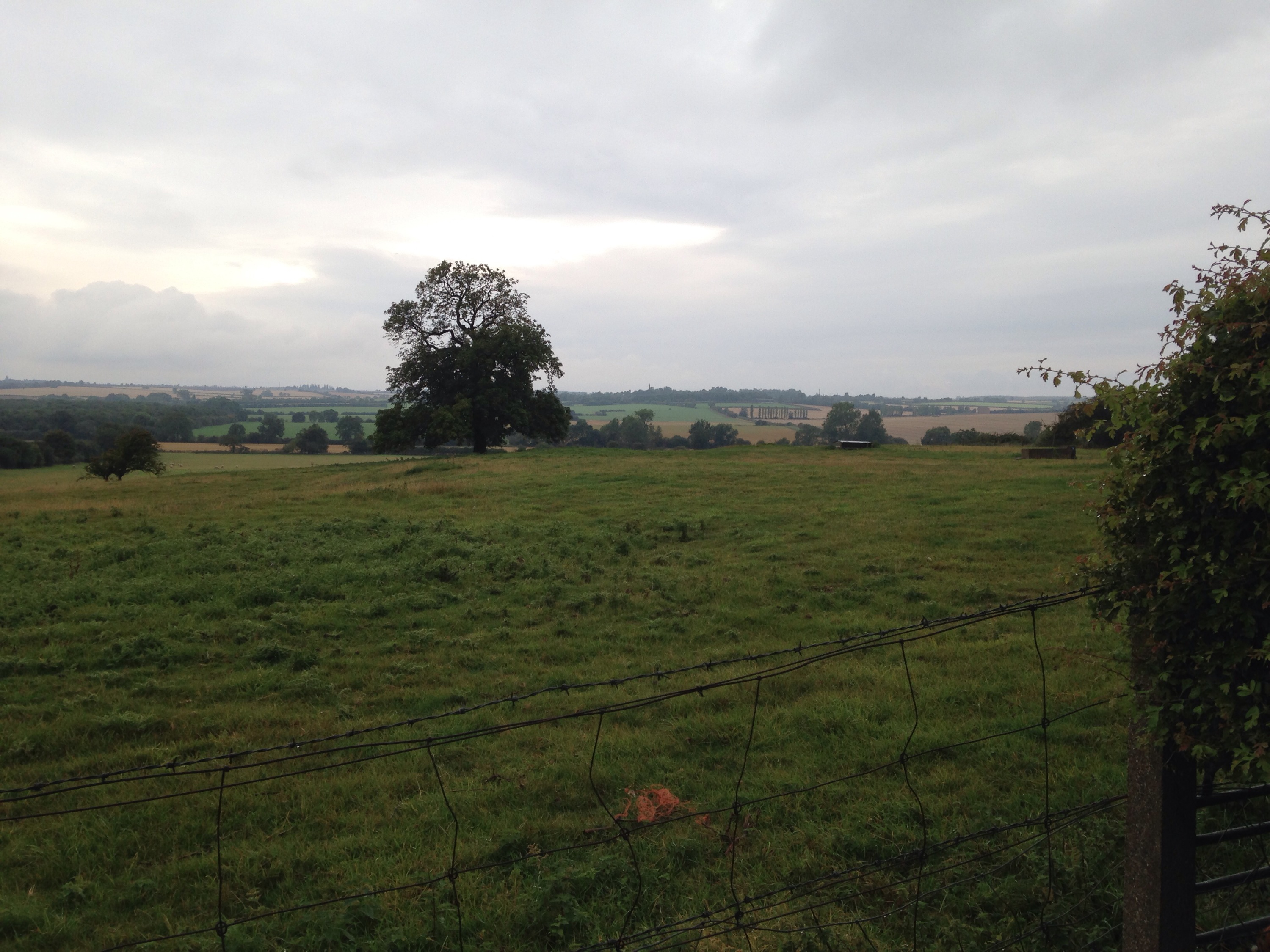
This weekend I arrived where I started. Leaving the rough road, I came past that same pig-sty to the dull facade and the tombstone. I arrived where I had started my Christian journey.  Past the  house where I learnt to play and share and discovered hospitality, through the garden where we fell off climbing frames, picked horseradishes and, later, celebrated my sister’s wedding, to the little church where I was baptised in 1970, where I first felt the presence of prayer as a young child, where sacred stillness was etched into my soul over months and years.

We lived at Little Gidding as a family from 1973 to 1977, when my parents started a community there which modelled a life of prayer, hospitality and care for creation. I remember this time as filled with people, animals, singing, shared meals and laughter. It wasn’t a perfect time but it has shaped me deeply.  For another four years we lived in the neighbouring village of Great Gidding where my father was  vicar. And so the Giddings were like a faded canvas, the backdrop to my childhood memories until 2005 when my parents moved back to the same house in Little Gidding for another three year stint as wardens of the retreat centre there.

During that later spell, my children in turn played on the lawn, some of my friends experienced this strange end-of-the -world  place and I had once more the chance from time to time to allow the rhythm of prayer to soak into my soul.

Then this weekend, taking a break from a hedonistic, noisy and vibrant music festival,  I arrived at Little Gidding as a deacon to preach while my father took evening prayer.  This was an immense privilege for me. Not only is the place full of poetic and personal resonances but I was also standing in the footprints of Nicholas Ferrar, one of the most famous deacons in the Anglican church who, with his household, lived a life of prayer, service, faith and compassion. And it’s Nicholas Ferrar who is buried in the tomb outside the church which mentioned by Eliot in the poem.

My texts were the Passover and the Beattitudes, texts core to the identity of Jews and Christians respectively.  And in a place that formed me I talked about the observances that form us in our faith.  In a place where communities of people  have put their faith into practice over 400 years I had the chance to talk about corporate memories of liberation and the promise of God’s blessing for those who practice vulnerability, those who visit places of powerlessness and those who live in solidarity with the poor.

In front of my parents and the gathered saints of that congregation I felt barely able to preach to those who  have lived for many decades in the shadow of Little Gidding and know the truth of living long faithful lives. But what I said seemed to matter little – in that place it was so clear that my sermon  and my service is merely a drop in a wide river of faithful Christian witness that spans centuries and runs so deep that it appears to have no end.

“There are other places
Which also are the world’s end, some at the sea jaws,
Or over a dark lake, in a desert or a city–
But this is the nearest, in place and time,
Now and in England.”

Little Gidding


An Altar in the Ordinary

As a deacon, the way people find it most easy to distinguish me from a priest is by reminding me that I cannot preside at the Eucharist. And indeed they are right. I can’t and shouldn’t preside at the Eucharist in church where it is the role of the leader of the Eucharistic community to preside at communion.

But as a deacon I can and will lead home communions and as I train for all aspects of my ministry I have been privileged to attend three home communions, led by three different people in three different parishes. Each has been special, moving and memorable. These tiny services or acts of service with just two or three people present seem to be a glimpse of the Church at its kindest.

Through these simple services people at risk of isolation through ill-health, old age or other issues are kept in communion with their church. For an hour or so they host the Church in their home and receive both company and compassion while being given the chance to take part in worship and prayer.

At the last service I went to I was struck by the huge symbolism of these moments. The minister lays a clean, white, ironed cloth out wherever there is a space. On a coffee table covered in tabloids and celeb magazines, on a bedside table covered in medication or on a small garden table surrounded by overgrown plants. The cloth is called the corporal – a word which means body – and immediately we see the significance of the incarnation. God is dwelling in these ordinary spaces, God is living among us; not only in the holy places and the clean places and the extraordinary places but in the front room, at the bed-side or in the back yard.

On this cloth is placed the shiny silver chalice and paten, the cup and bowl made in miniature and holding the elements that are blessed and become for us the body and blood of Christ. The ordinary table becomes an altar. The ordinary stuff of food and drink becomes for us the living Christ. An ordinary visit becomes a time for the extraordinary to be imagined and embodied – the life of wholeness beyond the suffering is glimpsed in a moment. Reconciliation, forgiveness, healing, nourishment, community are tangible in this time. For me, these tiny services have become the holiest of communions. I suddenly see the point of tenderly ironed linens, buffed silver and delicate wafers.

Scaling this symbolism up has given me a new way of looking at Sunday mornings too. In a place that is prepared and preened to be beautiful and special, we are making an altar in the ordinary. Our churches are in ordinary neighbourhoods full of longing for holiness, in an ordinary world longing for an extraordinary peace. Our lives are ordinary but our taking of communion points us towards the extraordinary.

The ordinal for deacons suggests that the love of God will be made visible in the forgotten corners of the world. A white cloth, a silver cup and bowl, a wafer and a sip of wine can reveal the love of God in all its facets in the grandest cathedral or in the most humble living room. It’s a privilege to preside in forgotten corners – let us never get too busy for home communions.

Go in Peace….

A friend’s facebook page has reminded me that we are 27 days into our new curacies. But this week I have been very aware that I am also only 28 days away from being a member of a different congregation just a couple of miles down the road. All Saints Kings Heath was my home for nearly 20 years and is where my children have been nutured and supported. This week, All Saints as well as many others are grieving the death of an amazing saint. It was a privilege to worship with John Hull and be taught by him at the Queens foundation.

So just at the moment, despite the amazing welcome and support I have been given by my new church,  I found myself wishing I could grieve with others who knew him. I want to share memories, laugh and cry with some of the people who appreciated this wonderful human being.

But in the mean time I need to get on with being the new curate. Its fun and unnerving to be the the new person again and to get to grips with slightly different patterns of worship, new personalities and a different context. Unsure of exactly what I should be doing, my favourite line of the Eucharist at the moment is definitely the last one: Go in peace to love and serve The Lord. It signifies that I have got through another service without a catastrophe but also reminds me and I hope others that our love and service flows out from the liturgy into the week. It is, perhaps, the most diaconal moment.

I have got so fond of this line that In my head I have named two of the beautiful windows in our church ‘love’ and ‘service’. Love is a stunning depiction of the nativity which is in the Lady Chapel, the space where our more intimate services are held. There is such warmth in the gaze of those surrounding the infant Jesus that you can nearly feel the adoration. Its a wonderful backdrop for worship. Service depicts the moment when Peter is restored by Jesus after his denial and he is commissioned to feed the sheep.  After a busy morning preaching and deaconing at the 8am and 10am I found myself hovering nervously in church when this window caught my eye and I was transported back more than 20 years. Back in my student days I had returned to my bedsit after a night running a mission discouraged, exhausted and perplexed. The words Feed my sheep were spoken to me out if nowhere – I was not sure what they meant but then they gave me the courage to continue and they have been a recurring refrain over the last two decades as I made my way towards ordination as a distinctive deacon. Now they remind me that I am where God wants me to be.

But combining a diocesan role as well as the work in a parish I have found myself wondering how on earth to juggle love and service. It can feel like there is a tension between the two. With so much to do how do I find time to spend adoration and wonder? With the responsibilities and commitment I have now made to prayer, study and worship leading how do I have time to do anything else? I know others feel the same tension. Is it asking too much to do both? Should I really end the service with the words: Go in Peace to love or serve The Lord.

As I write and reflect  this week my mind is full of fragments of the lively, challenging and humourous conversations I had with John Hull over the years and the wisdom and insight he shared in his teaching. Knowing John makes it impossible to consider for more than a moment  that love and service could ever be separated. John’s love for God was embodied in a life of service. John’s service was embodied by his love of people. John’s love for people permeated his writing and thinking, his conversation and campaigning and his teaching and understanding. He wrote about the love of God collapsing into the love of neighbour – meaning the love of God is lived by loving the other.

What John has taught me above all else is that service without love is not really service. What we can really offer people is ourselves, our friendship, our insights, our humour and our compassion. Its important to meet physical needs but its even more important to be open to the other, to be willing to change and be changed through an encounter. John also taught me that love without service is not really love. As we read in the Epistle of James, we cannot claim to love God if we do not love our brother and sister. So Go in Peace to Love and Serve the Lord makes perfect sense – it is impossible to do one without the other because they cannot be divided.

John has gone in peace leaving a legacy that has and will continue to spur many of us to lives of love and service. It’s hard to say good-bye to the people and places we have loved but it is a massive privilege to be in the place where God has called me not only to feed his sheep but to learn from them and with them as we journey towards perpetual peace and joy.

Deacon at last… musings on the first week

After perhaps 5, perhaps ten, perhaps forty-five years of formation I became a deacon on Sunday. It was a glorious beautiful day full of fun, laughter, sunshine, joy, family, friends and Holy Spirit. In some ways I had been stressing about the day – I was worried I had not got a clear understanding of what would happen and I found it hard to define what would change and what wouldn’t. Would being ordained stop me being ordinary?

Now in this first week, having spent one day off, one day in clergy training, one day in work and one day in the parish, I wanted to reflect on what has changed and what has stayed the same.

Being in the parish wearing a dog collar a lot has changed. People either make noticeably more eye-contact than before or noticeably less. I have chatted to a PCSO about a road accident, answered a question in the garage about ecclesiology and joined other clergy for Morning Prayer in my new church. In the parish I am first and foremost an ordained person and with my dog collar on I cannot forget for a moment that I am a visible sign of the church.

But in a way nothing has changed. For the last 20 years I could have answered the questions I was asked in the garage, I would always have wanted to know how the person in the accident was doing and would certainly have prayed for them as I walked away and I have been joining morning prayer at my home church for at least the last four years. So I have not changed but the way people respond to me has changed and the dog-collar has brought to the surface the faith and theology that lies within every follower of Jesus Christ. So I am asking myself the same question – should all Christians wear a visible symbol of their faith? Or should ordination to the diaconate be a next step for most Christians? Should it follow on from baptism and confirmation and affirm the lifelong commitment to discipleship made by many people who are not ordained?

People told me the day of ordination would be like a wedding. While there are some similarities I was wary of this imagery. I do not want my new ministry to be in any way a rival to my marriage, which is also a vocation and one I try to take seriously. However it some ways it was like a wedding, the presents, speeches, the sense of not having time to talk to all the wonderful people who have gathered to support you, the service itself, the symbolic clothing and the parties which in my case finished in an ice-cream parlour at 1 am on Monday morning. But on a deeper level it was not like a wedding. And when I collapsed exhausted at the end of the day, sitting next to my husband in my normal clothes it was as if nothing has changed. I am still me, he is still him and our relationship is unchanged. It’s the same with the children and at the moment I have decided not to wear my dog collar in the house.

It’s also, for me, the same with God. While being prayed for by the Bishop in the service was amazingly moving, affirming and equipping and the sense of God’s presence filled me with an incredible lightness my relationship with God remains unchanged. I am not in a special elite gang nor do I now have to earn favours through overwork and grovelling.

So Sunday meant the world to me. The buzz was incredible and I still feel like I am floating on air. (Monday was terrible, I am sure I had a Holy Spirit hangover and I had to nap most of the day). It seems to have meant a lot to my friends too and my family and the cards, presents and kindness I have received have been overwhelmingly generous.

But what it also says to me is that there is a vast potential for ordinary ministry by ordinary people in all sorts of ordinary settings if we are willing to make visible our love for God, our compassion for our neighbour and our commitment to our communities.

Places of Welcome – a sermon

On Sunday I preached to a church that is joining the Place of Welcome network. The readings I had chosen were the Genesis story of Abraham welcoming three strangers to his tent at Mamre and the story of the Emmaus Road when the disciples invited Jesus home and recognised him in the breaking of bread. Plenty of people support the Place of Welcome network simply because it is a good thing to do – and as I have said in my previous blogs – we are made for goodness. However if anyone wants a bit of theology to support any kind of activity that encourages strangers to become friends I hope this sermon is helpful in some way.

“It’s very easy to live in a box. Not literally living in a cardboard box because we don’t have a home but nevertheless many of us live in a box.

The size of our box probably depends on our personality. Some people may allow no-one in their box because they have been hurt or damaged by relationships that have gone sour. Others have a whole heap of family and friends and there is laughter and joy, with occasional times of sorrow and grief within the box. We pray for the people in our box, we spend most of our time with the people in our box, we probably spend most of our money on the people in our box and we fear losing anyone that belongs in our box. And there is much that is good, wholesome, loving, kind and true in those relationships given to us by God.

But we might find that most people in our box are quite like us. They may well be of the same faith as us, the same ethnicity, been to the same kind of school or do the same kind of job.

Churches can be a box too – often our buildings look like a giant box and the door can literally be very hard to find. When I worked for the Church of England in Birmingham I had to go and visit lots of churches and I can’t tell you how many times I walked round and round the buildings trying to find the one door that was unlocked so I could get inside and meet whoever I was supposed to be seeing.

After Jesus’s crucifixition, John’s Gospel tells us that the disciples went and hid in a box – a locked room. Jesus’s death took away their hope, their story came to a sudden and bitter end and they were overwhelmed by fear and despair.

The two men we met today in our Gospel reading were in a similar state. Their faces were downcast, they talked about Jesus in the past tense, and their hope of redemption for themselves and their people was no more.

In their grief, their unknowing, their doubt and despair, these two men met a stranger and invited him home. And then they encountered the living, risen Jesus. Then communion and thanksgiving became possible.

There is a wonderful vagueness about the story from Genesis. We don’t know exactly who or what Abraham thinks the three young men are or what they represent. But he does not take any risks. He welcomes the strangers as if he we were welcoming God. He gives them food, drink, dignity and comfort. He doesn’t give them left-overs, he gives the best of what he has. And history and Church tradition has judged that these three men represent the three persons of the Trinity, Father, Son and Holy Spirit.

From this tradition has grown this beautiful icon which represents the fellowship within the Godhead but also clearly shows the space for us to enter in and join that fellowship, for us to sit and eat with God, Father, Son and Holy Spirit.

Rublevtrinität_ubt

There is much about the Trinity that can be confusing but I love the fact that the Trinity illustrates that there is both relationship and difference within the very heart of God’s being.
And I believe that God wants us to have relation and difference in our own boxes, because as Christians we are called to be more and more like God.

But it might not be practical for us to go on to the streets and invite the stranger home. We can’t force friendships with people who are different from ourselves. Some things are very hard to do, particularly if we try and do them alone.

That’s why your church is joining the network of Places of Welcome. This is a movement of places of worship and community centres that are committed to offering hospitality, a place to belong, to whoever needs company and conversation in a local neighbourhood. The network began about three years ago and we now have 43 active Places of Welcome, most of which are in Birmingham with a few elsewhere across the midlands.

These places are branded with a simple logo and can be found on a website so that people can recognise a safe place to find conversation, a cup of tea and a biscuit. They are staffed by volunteers who are willing to allow anyone to join their conversation and can offer a bit of local information.

It’s a very simple offer but it can make a huge difference to someone who has recently arrived as an asylum seeker, become unemployed, got divorced, moved house, been bereaved or become unwell – the list could go on because any of us could find ourselves facing loneliness at any time. And because we recognise that we all have gifts and we all have needs we try to keep the gap between host and guests as small as possible and we find that very quickly the quiet man who was spending hours doing job search on the computer is fantastic at making soup, or the woman who recently arrived from Cambodia is a Maths teacher and can help a child with their homework.

This church already does a lot to open its doors to the community. (And so might your church)

But I believe God calls us as churches and individuals to open our doors even wider and maybe even break open the walls of our boxes so that we can encounter God in the stranger we meet and be converted, transformed into the likeness of Jesus, by the encounters with those who can open our eyes and ears to new truths, fresh insights and deeper understanding.

Just as we have been welcomed by Jesus to join in the conversation and to sit and eat with him, I am convinced that we are then called to welcome others, knowing that the stranger bears the image of Christ through whom we find our salvation.”


Network Overload?

One of the tremendous privileges of my work and job is being part of lots of networks of people who do fantastic things because they are inspired by their faith (in God or in humanity).

As a paid worker I am sometimes overawed by people who find time for their service to God and the world between work, family, worship and recreation.  But being paid full-time to hang out with people like this (people like you) I have a wonderful helicopter view of the network of love in action that is criss-crossing this city linking churches, gurdwaras, synagogues, temples, mosques, Near Neighbours projects, Places of Welcome, arts projects, environmental action and the support of vulnerable people such as refugees and asylum seekers.

Sometimes there is the chance to get some of this network into one room and the effect is always wonderful. To quote Desmond Tutu in Made for Goodness again: “You can see from the people we truly admire that we are attracted to goodness. We do not revere people who are successful. We might envy them and wish that their money were transferred to our bank account. But the people we revere are not necessarily successful, they are something else. They are good.”

That’s why it is fantastic when the networks of good people come together. But I am also concerned that the more networks we create, the more day conferences we hold, the more seminars we run and the more workshops we attend the less time we have to do what it is God has given us to do.

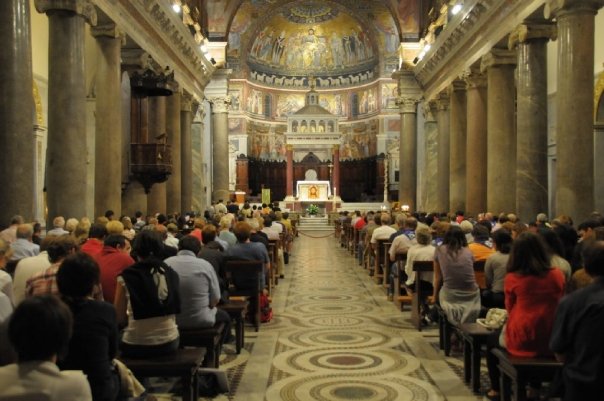
However I think my concerns are unfounded. One of the best networks I have ever come across has a daily meeting. At 9pm. For prayer. Six years ago I was privileged to spend an evening with the San Egidio community in Rome. This is an amazing global network of communities without borders of people who are committed to Friendship with the Poor expressed in hundreds of practical ways.  For example, on Christmas Day 2013, the lunch with the poor, a tradition of the San Egidio community that dates back to 1982, gathered 165,000 people for 1,100 lunches in 74 countries around the world, among them about 22,000 prisoners. I experienced their practical love in action after the short service in the Trastaverte district  when we went to an amazing trattoria connected with the community which was staffed by people with learning difficulties and celebrated those people’s gifts and talents in ways I have never forgotten.

San Egidio

This is not a particularly brilliant picture of this part of the San’ Egidio community at 9pm on a normal Tuesday evening. But their worship reflected the hospitality of their lives. The service was easily accessible and translated into several languages. Old, young, able-bodied and those with disabilities, rich and poor were welcomed together and the quality of relationships was evident – no-one wanted to leave after the service finished.

Alongside prayer and service, the community is committed to communicating the Gospel, ecumenism and dialogue – all things I would happily sign up to and I know many people in this city whose lives model all those values. But I know many others who would love the ethos but belong to different faith traditions.

So this blog is really a question. Does the San’ Egidio community offer something to a city like Birmingham? What might it look like if it grew out of intentionally multi-faith gathering or would separating it from the Church loose the essence of the movement?

Hard-wired for Goodness?

A set of statistics has been ciruclating on social media today outlining the probability that certain jobs will be replaced by computers or robots. For telemarketers the probability is 99/100, for clergy it is 8/1000. Dentists, athletic coaches and recreational therapists are less likely to be replaced by robots than clergy – most other professions including accountants, chemical engineers, airline pilots and editors are more likely. I guess it depends how much of the job requires you to respond to unlimited different cirucmstances rather than following a prescribed set of behaviours.

I wonder too if it is to do with how much of the job can be taught and how much is about personality, character and virtue – undefinable and unquantifiable attributes that bring the best out of people, calm fears and motivate others. (Although my dentist has never yet persuaded me to floss!)

As part of my dissertation I asked around 30 people in a questionnaire what skills and attributes they would look for if they were recruiting a deacon – a kind of clergy person. What came back was not a list of skills, theological degrees or technical know-how but more a list of virtues. Worlds like prayerfulness, compassion, enthusiasm, humility, commitment and openess.

In fact reading the list – and its amazing that 30 people found 30 different ways of saying almost the same thing -I could see they wanted to recruit a deacon that was basically like Jesus. If you ever read the Church Times job adverts for fun you see pretty much the same thing. Everyone wants a vicar who walks on water and can turn water into wine (or perhaps that’s just me!)

It is a oft-quoted idea that the people who irritate us most are those who share our flaws and shortcomings. Conversely, I think that people like to be around other people who reflect back the virtues they have come to recognise in themselves. So Christian disciples want their ordained ministers to reflect the virtues and character that have been formed through their practice of faith -consequently in a church of 100 people that’s a lot of virtue being looked for in one person!

With my book group, I’m reading at the Desmond Tutu’s book Made for Goodness. His key arguement is that humanity if fundamentally good. We know this because we revere good people and we view evil and wrong as aberrations. He says: “Evil cannot have the last word because we are programmed – no, hardwired – for goodness…To be hateful and mean is operating against the deepest yearnings that God placed in our hearts. Goodness is not just our impulse. It is our essence.”

I wonder if our collective behaviour as the Church of God would change if we truly believed that God has made us in God’s image and hard-wired us for goodness. We talk a lot about sin in our liturgies and our prayers and while its good to stay humble and aware of our need of God, perhaps our sense of impending failure limits our capacity for goodness.

Its hopeful that the church (or the bit I have surveyed) wants its clergy to be good – courageous, humble, rooted, open, committed and flexible. It’s a daunting task certainly for this flawed human being but I think it might be even harder for a computer.

But if and when the computers replace the telemarketers, the accountants, the shop assistants and the estate agents I hope they too are hard-wired for goodness and are programmed to respond to a note of desperation in a voice, a look of despair or a gesture of hopelessness. And from time to time I hope they can perform random acts of kindness that lift the spirit and turn a transaction into a human encounter, or even an encounter with the goodness of God.